 Advice
Can You Track a Cat With a Microchip?
No, you cannot track a cat with a microchip. It is one of the most common misunderstandings in cat ownership, and it costs owners precious time when a cat goes missing.
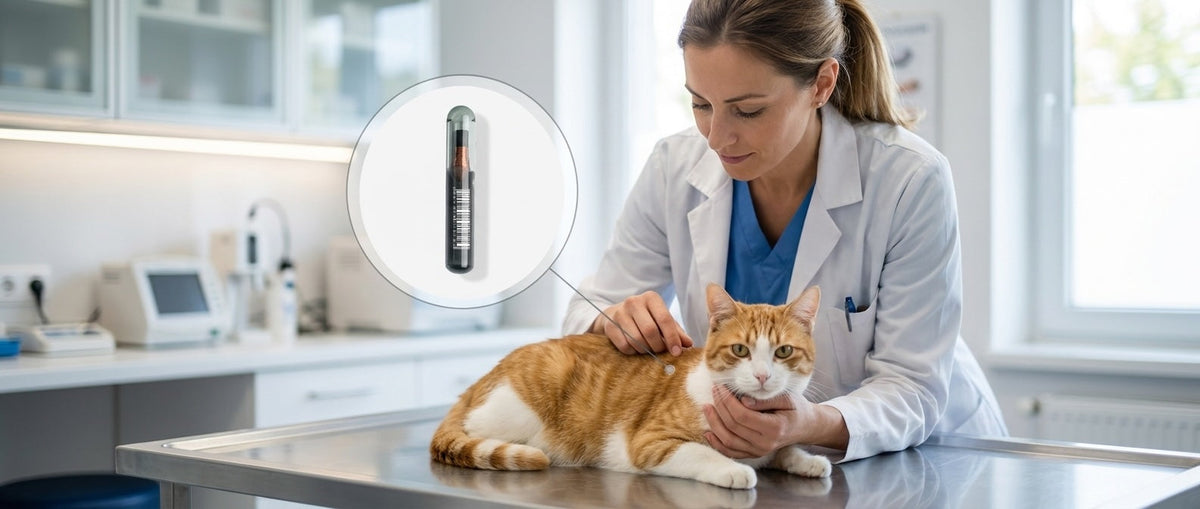
A standard pet microchip is an identification device, not a GPS tracker. It carries a unique number that a compatible scanner can read once your cat is physically found, linking him back to your contact details on a database. It contains no GPS and does not transmit his location.
In short
A microchip has no battery, no GPS and no signal. It cannot be tracked.
It stores an ID number that a vet or rescue centre can read with a scanner.
It works after your cat has been found, not while you are looking for him.
To actively track a cat's location, he needs a separate powered device, normally worn on the collar.
Want him findable as well as identifiable? See the petTracer recovery system →
What does a cat microchip actually do?
A microchip is a tiny passive implant, about the size of a grain of rice, placed under the skin between the shoulder blades. It holds one thing: a unique ID number.
When a found cat is taken to a vet or shelter, they scan him, look the number up on a database, and ring the owner. That is the entire system, and within its limits it works well.
But notice the order of events. Someone has to find him, catch him and take him to be scanned. The chip contributes nothing to the search itself.
Can a microchip help find a missing cat?
Yes, but only indirectly. If somebody finds your cat and takes him to a vet or rescue centre, the chip is how he gets identified and returned to you. What it cannot do is show you where he is: there is no live position, no GPS, nothing to follow.
In other words, a microchip supports the reunion, not the search. It is no substitute for actively looking for him.
Why does the misunderstanding cost so much time?
Because it can encourage waiting. An owner who believes the chip itself can be traced may sit tight for a day or two, expecting a phone call. But a microchip only helps once somebody has physically found the cat and had the chip scanned, so that call depends entirely on someone else finding him first.
The research points towards searching instead. A 2018 study of 1,210 missing cats (Huang et al., published in the journal Animals) found that 75% of located cats were within 500 metres of where they went missing, and among cats found alive with a recorded distance, the median was just 50 metres. Indoor-only cats tended to be found closer than cats used to roaming unsupervised, and the study concluded that thorough physical searching, particularly within the first week, was a useful strategy. A missing cat may be hiding nearby, or may have been accidentally shut inside a shed, garage or neighbouring building, so checking those places early is well worth it.
The early days are when a methodical local search does the most good, and delaying it while hoping for a phone call gives them away.
Do cats need both a microchip and a tracker?
Yes, ideally, because they solve different problems. The chip identifies him after he is found. A tracker gives you information you can act on while he is missing.
The microchip is permanent and works even if he loses his collar. In England, pet cats must be microchipped and registered on an approved database by 20 weeks old; in Scotland, Wales and Northern Ireland it is currently voluntary, though widely recommended. Wherever you live, keep the registration details current. The chip stays readable either way, but out-of-date contact details can make reuniting you with him much slower.
A tracking collar is what lets you do something while he is missing. petTracer is a cat recovery system: GPS shows the area he is in outdoors, and at close range the HomeStation reads the collar's radio signal strength, so you can tell whether you are getting closer or further away, even when he is inside a building and staying silent.
How do you actually find a microchipped cat?
You search for him, and the right tools give the search a direction. petTracer's collar weighs 34 g and combines GPS with radio. GPS narrows things down to a search area. The HomeStation then doubles as a hand-held finder that reads the collar's radio signal strength, growing stronger as you close in on him.
Step 1
GPS finds the area
Outdoors, GPS shows you roughly where he is, so the search starts in the right place.
Step 2
Radio closes the distance
At close range, you follow the collar's radio signal strength to home in on him. Radio can work through walls.
Step 3
The app and HomeStation
The HomeStation charges the collar and doubles as a hand-held direction finder.
"Now we know exactly what her territory is. She's living her best life, knowing she can come back home whenever she wants. And we no longer have to worry about where she is. Thanks to the collar."
Martha's owner, after five weeks missing · read the full story
petTracer recovery system
Built to recover missing cats, not just track them.
Ultralight 34 g collar, designed exclusively for cats
GPS to establish the search area outdoors
Close-range radio search that can work through walls
Up to 7 days of battery in normal use, around 30 in Eco mode
Swiss engineered, with 30 days to try it
See the petTracer recovery systemSwiss Made · 30-day returns
Keep the chip. Add the search.
Chip him, register it, check the details yearly. None of that changes with a tracker on his collar.
Just be clear about what each one does. The chip brings him home if a stranger finds him first. A recovery system means you do not have to wait for a stranger.
Identified is good. Findable is better.
The petTracer recovery system: GPS to find the area, radio to find the cat.
See the petTracer recovery system30 days to try it · Free UK delivery · Swiss Made
Common questions
Can a vet track my cat's microchip?No. A vet can read the chip's ID number with a scanner when the cat is physically in front of them. The chip cannot transmit anything, so there is nothing to track.
Is there a microchip with GPS for cats?No. Standard pet microchips do not contain GPS and cannot provide location tracking. Consumer GPS trackers for cats are separate powered devices, normally worn on the collar.
My cat is chipped and missing. What should I do?Start an active physical search: check sheds, garages, outbuildings and hiding places nearby, and ask neighbours to open and check theirs. Report him missing to his microchip database, and contact local vets and rescue centres. Clear notices and local posts help too. How wide to search depends on him: an indoor-only cat is usually found closer to home than a cat used to roaming.
Does petTracer replace the microchip?No, it works alongside it. The chip identifies him after he is found. petTracer helps you find him: GPS for the search area, radio direction finding for the final approach.
Sources
Huang et al., Animals (2018): Search Methods Used to Locate Missing Cats and Locations Where Missing Cats Are Found
PetTracer product page